All Categories
Featured
Key Advantages of Specialized Risk Policy Models
Finding Term Coverage for HIV-Positive Applicants

New Policies for Applicants
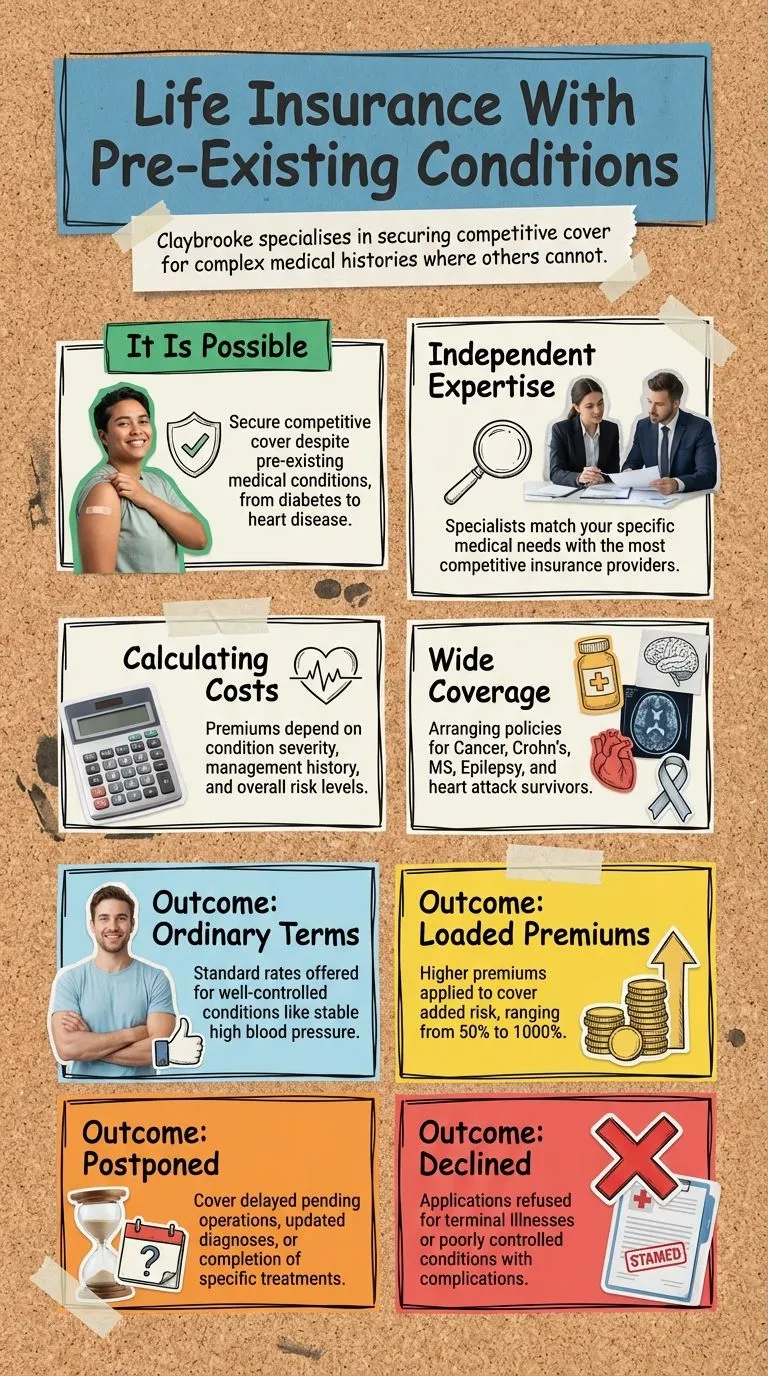
Medical conditions that are stable and well-managed inhabit a basically different underwriting position than conditions that are actively unstable, just recently complicated, or improperly treated even when the diagnosis name is the very same. Conditions that consistently create underwriting friction across most providers include recent or active cancer in treatment (where most providers postpone till treatment is complete and remission is developed for a specified duration), active symptomatic heart failure or extremely current major heart occasions, advanced kidney illness with considerably decreased function, serious COPD with documented oxygen dependency, and complicated autoimmune conditions with active organ involvement.
Our resource on life insurance for autoimmune illness covers the basic autoimmune underwriting structure, which uses across the classification with condition-specific variations. Blood clot conditions and deep vein apoplexy history present specific underwriting concerns around reoccurrence danger and anticoagulant therapy; our resource on life insurance for embolism history covers this discussion. Modern underwriting utilizes electronic prescription databases that provide a history of filled prescriptions, normally covering a number of years, that the carrier queries as part of the underwriting review. When the application disclosure is inconsistent with what that database shows, the provider interprets the disparity as an issue either a considerable medical concern that was left out from disclosure, or, in the worst interpretation, deliberate misrepresentation.
Each of these creates an inconsistency that slows underwriting, sets off extra inquiries, and in some cases produces a conservative result that would not have actually accompanied total initial disclosure. The option is precise and complete disclosure at the application phase not leaving out medications due to the fact that they seem small or because the candidate has normalized them as part of every day life.
Impaired Risk InsuranceContext must be supplied where pertinent a broker cover letter that describes a medication's sign, the period of use, and the stability of the underlying condition transforms a potential red flag into a recorded, contextualized disclosure that underwriters examine appropriately rather than conservatively. Our resource on what is MIB in insurance coverage covers how underwriting databases create cross-referencing that makes complete disclosure not simply ethical however almost necessary for the finest outcome.

Integrating Insurance with Special Needs Planning
Steady, cured depression with consistent therapy and medication management and no hospitalizations usually produces standard to slightly rated outcomes at numerous providers. The elements that develop major underwriting friction are recent hospitalizations, current suicide efforts (which produce postponements or declines at most providers for defined durations), extreme instability, several medication changes within a brief window, and patterns recommending continuous functional impairment.
Impaired Risk InsuranceThe provider that assesses mental health history most positively is often one with specific underwriting experience in behavioral health danger not the carrier with the very best general market premium. Substance use history follows the exact same pattern reasoning. A DUI from 7 years ago without any subsequent occurrences produces a very various underwriting action than 2 DUIs within the previous three years, even when both candidates explain themselves as "having had a drinking issue in the past." Continuous substance use condition, current inpatient treatment, and several substance-related occurrences produce the most conservative actions.
Life insurance coverage underwriting examines non-medical elements that affect death danger with the very same principle that uses to medical elements: intensity, pattern, and provider cravings determine the outcome. Dangerous professions business diving, offshore oil and gas work, mining, explosive handling produce underwriting friction because they represent elevated accident death threat that standard premium models may not properly cost.
High-risk avocations private air travel, motorsports, sky diving, rock climbing up at competitive levels are examined similarly: the degree and frequency of participation, the training and accreditation level of the individual, and the provider's existing appetite for the specific activity identify the outcome. Some carriers have strong flat additional schedules for particular avocations that produce insurable coverage with specified premium additions; others decline the thing entirely.
A formal decrease at one carrier creates an MIB notation that subsequent carriers can see when they query the database as part of their underwriting review. This notation does not avoid coverage at subsequent carriers it produces an additional question that must be dealt with. When an application discloses a prior decrease (as the majority of applications need), the brand-new provider's underwriter will evaluate not just the existing application but the context of the previous decline: why did the prior carrier decline? Has anything changed considering that the prior decrease that resolves the hidden issue? Is the existing provider being asked to take on a risk that a sophisticated peer carrier currently evaluated and rejected? This is why the tactical action to a prior decline is not to reapply arbitrarily and expect a different outcome it is to determine the particular factor for the prior decline (often divulged in the carrier's adverse action notice), then identify whether that reason is addressable through much better documentation, enhanced stability, a different product type, or a provider with different standards for the specific concern.

Latest Posts

Why Custom Risk Underwriting Matters in 2026
Key Advantages of Specialized Risk Policy Models
Finding Term Coverage for HIV-Positive Applicants